
*This is an article about USA Hockey. I wrote it in Canada.
January 3 — Gothenburg, Sweden.
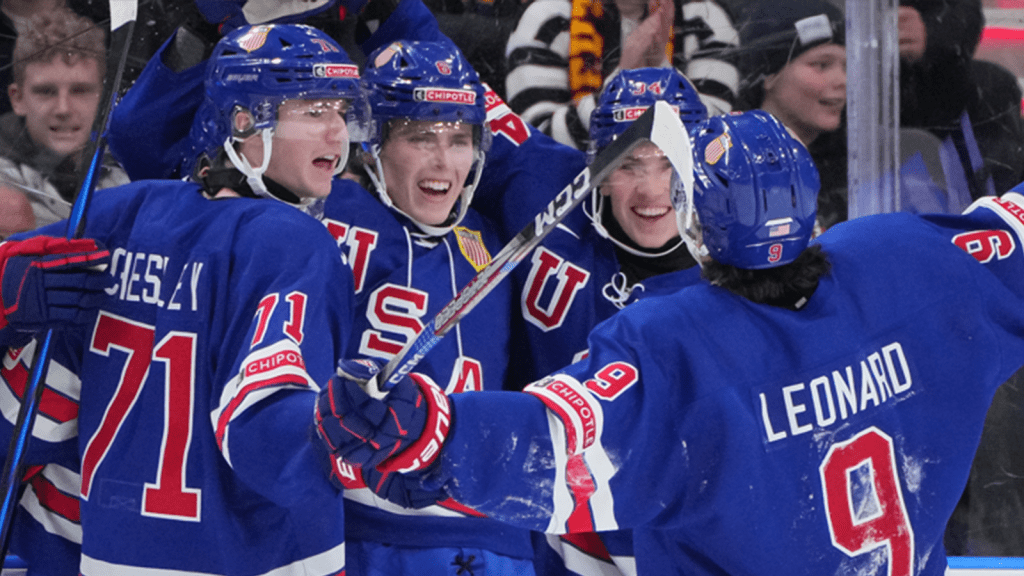
It was a night to remember for the United States. The U20 men’s team had just defeated Sweden to win gold at the World Junior Championship, claiming their seventh medal in the past 10 years and their third gold medal in that same time frame. The final horn triggered the same jubilant celebration we’ve come to expect from the tournament finale, but that doesn’t make the moment any less special for the team and its fans.
The players have since returned across the pond to their respective clubs. Jimmy Snuggerud earned two goals in his first game back with the University of Minnesota. Trey Augustine registered a shutout in his return to Michigan State. And the Boston College trio of Will Smith, John Leonard, and Gabriel Perrault combined for seven points on Friday against Providence.
Team USA was the favorite entering the tournament — even over Canada, who couldn’t pry top players like Connor Bedard, Adam Fantilli, and Shane Wright away from their NHL teams. But that disclaimer does not, and should not, discount the talent on the United States roster, which could go down as one of the best in tournament history.
It’s a testament to how far USA Hockey has come, both in terms of player recruitment and player development.
Registration numbers have skyrocketed since the 1990s, jumping from 195,125 players in 1991 to over 510,000 in 2013. That’s a 160% increase in two decades, which well outpaces the country’s population growth (26.4%) in that time.
Today, the organization has over 556,000 members across the nation, including in what many would call non-traditional hockey markets. We can likely thank the NHL expansion franchises of the 1990s for that. We’ve already seen a number of NHL players come from these regions — including Auston Matthews (Phoenix), Matt Nieto (Anaheim), and Dustin Wolf (San Jose) — and that trend seems to be continuing.
Cutter Gauthier, now a top prospect of the Anaheim Ducks, was born in Scottsdale, Arizona. 2024 draft-eligible defenseman Zeev Buium is from San Diego. Four players who represented Team USA in Gothenburg came from the state of Florida.
The game has expanded beyond Massachusetts and Minnesota, and it’s showing in the American prospect pool.
This extends to the women’s side of the game as well. In fact, female year-over-year membership has outgrown its male counterpart in each of the last seven years. And of the 88,000 girls and women with a current USA Hockey number, over 17,000 of them live in the Pacific and Central regions of the United States.
At the end of the day, more Americans are picking up hockey sticks, which means USA Hockey has access to top-tier athletes who, in the past, may have chosen to pursue a sport like baseball or football instead.
And the organization has taken steps to better develop these athletes as well.
In 2009, USA Hockey unanimously approved the American Development Program — a new approach to youth hockey that blends sports science with child development. It has since become the global standard for training and has led to increased performance and retention in the U10, U12, and U14 age classifications.
They’ve also embraced the latest in sports technology, forming a partnership with Applied Cognitive Engineering that led to the creation of IntelliGym in 2010. This advanced computer-based platform was designed to elevate a player’s hockey sense and pattern recognition to improve decision-making on the ice. Over 60,000 skaters have used it to date, including NHL players like Matt Nieto.
But the United States does need to give a little bit of thanks to their neighbors to the north. Over the years, there has been a growing number of American players with Canadian parents who played professional hockey.
Ottawa Senators defenseman Jake Sanderson was born in Montana, but his father, who played over 1,000 games in the NHL, is from the Northwest Territories. Gabriel Perrault, the New York Rangers first rounder mentioned near the top of this article, has a similar story. The same can be said of Tage Thompson and Josh Norris. And if your parent knows what it takes to play at that level, then you likely have the inside track to get there as well.
All of this — from the increased membership to the improved training — has led the country to enter a new era of dominance.
Between 1977 and 2009, the United States earned just five total medals at the IIHF World Junior Championship. The team has won 10 since then, including five golds. They’ve also taken home four medals at the IIHF World Hockey Championship in that same span after winning only three in the previous 50 years.
The success has translated to the NHL as well.
Americans finished among the top-10 in points 17 times between the 2010-11 and 2019-20 seasons, a feat that was accomplished only four times during the previous decade (Doug Weight in 2001, Mike Modano in 2002, Zach Parise in 2009, and Patrick Kane in 2010). And with players like Auston Matthews, Matthew Tkachuk, and all three Hughes brothers in the fold, the once-rare occurrence looks poised to become more of the norm.
Canada may still very well be the Goliath of the hockey universe, but the United States has certainly graduated from the roll of David. They have become a threat. They have become a contender. And, in some cases, they have become a favorite.
And nowhere was that more apparent than two weeks in Sweden, when a bunch of teenagers took on the world.
And won.
 Pucks Over Glass
Leave a comment