
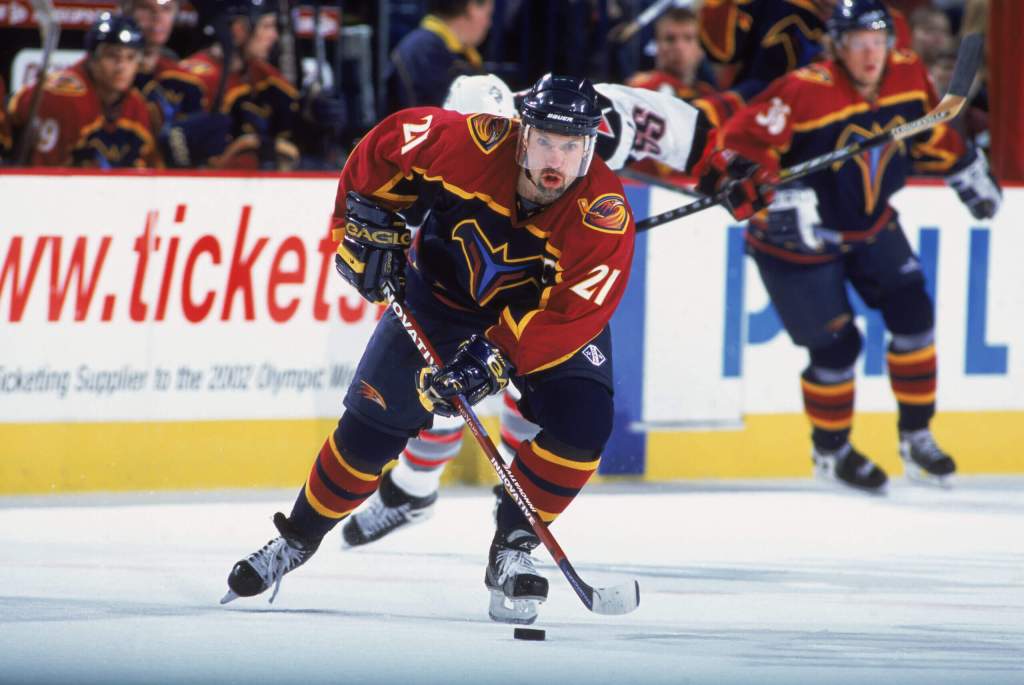
“No one ever lost a trade to the Thrashers.”
It’s only part of the story, but this quote from media personality Steve Dangle encapsulates the misfortune and mismanagement of the Atlanta Thrashers — a team that saw much more misery in its history than success.
The Thrashers were the second attempt at bringing NHL hockey to the Atlanta area. But like their predecessors, the Atlanta Flames of the 1970s, they had little more than a cup of coffee before shipping off for a Canadian market.
(The Atlanta Flames would go to Alberta and turn into today’s Calgary Flames, while the Atlanta Thrashers would become the current iteration of the Winnipeg Jets.)
With another NHL expansion seeming inevitable, many have speculated if the league could return to the market for a third time.
But can hockey survive in Georgia? Could the third time really be the charm?
Let’s dive into the most recent version of Atlanta hockey to dissect what went wrong and explore if hockey can be viable in the region.
The Pain of Previous Expansions
Let’s go back to where it all started: Boston, Massachusetts.
It’s 1999, and Thrashers general manager Don Waddell is preparing to select the first players for the franchise at the NHL expansion draft.
But remember, this is long before the era of expansion teams being set up for success, and the rules surrounding these drafts were dramatically different than they are right now.
Today, the teams can typically protect:
- 7 forwards, 3 defensemen, and 1 goaltender, or
- 8 skaters and one goaltender
In Atlanta’s year, however, the situation was not so lenient to the incoming franchise, with organizations being able to protect either:
- 9 forwards, 5 defensemen, and 1 goaltender, or
- 7 forwards, 3 defensemen, and 2 goaltenders
It’s also worth remembering the NHL had an expansion draft the previous year when the Nashville Predators entered the league.
This put more restrictions on who would be available for the Thrashers, as the Predators were exempt from the entire process. On top of that, teams that lost a goaltender in the 1998 expansion could not lose one again in 1999 (those teams were the Anaheim Ducks, Los Angeles Kings, Montreal Canadiens, New Jersey Devils, and the New York Rangers).
These two circumstances left Waddell with little more than fourth-line forwards, bottom-pair defensemen, and backup netminders to pick from. So with those restrictions in place, the team selected the following players:
1. Trevor Kidd (G) – Carolina Hurricanes
2. Norm Maracle (G) – Detroit Red Wings
3. Corey Schwab (G) – Tampa Bay Lightning
4. Petr Buzek (D) – Dallas Stars
5. Brett Clark (D) – Montreal Canadiens
6. Kevin Dean (D) – New Jersey Devils
7. Maxim Galanov (D) – Pittsburgh Penguins
8. David Harlock (D) – New York Islanders
9. Jamie Pushor (D) – Mighty Ducks of Anaheim
10. Darryl Shannon (D) – Buffalo Sabres
11. Chris Tamer (D) – New York Rangers
12. Mark Tinordi (D) – Washington Capitals
13. Yannick Tremblay (D) – Toronto Maple Leafs
14. Kelly Buchberger (RW) – Edmonton Oilers
15. Sylvain Cloutier (C) – Chicago Blackhawks
16. Phil Crowe (RW) – Ottawa Senators
17. Peter Ferraro (RW) – Boston Bruins
18. Johan Garpenlov (LW) – Florida Panthers
19. Jody Hull (RW) – Philadelphia Flyers
20. Matt Johnson (LW) – Los Angeles Kings
21. Tomi Kallio (LW) – Colorado Avalanche
22. Steve Staios (RW/D) – Vancouver Canucks
23. Mike Stapleton (C) – Phoenix Coyotes
24. Ed Ward (RW) – Calgary Flames
25. Terry Yake (C) – St. Louis Blues
26. Alexei Yegorov (RW) – San Jose Sharks
The highest point-getter from that group in the previous year?
Terry Yake.
With 29 points in 60 games.
(Yake never actually played for the Atlanta Thrashers. In fact, he remained with the St. Louis Blues the following season. After some research, I was unable to find out why that was the case. Please let me know in the comments if you know what happened.)
For comparison, the Seattle Kraken drafted five players with more than 27 points the year prior. And the kicker: That season was only 56 games long due to the COVID-19 pandemic.
Bad Draft Classes. Worse Drafting.
The expansion draft was unkind to the franchise, but the 1999 NHL Entry Draft was the next day. Another chance at a great start was coming their way with the number one selection in their hands.
And with the first overall pick, the Atlanta Thrashers select:
Patrick Stefan.
Despite his draft status, Stefan would put up just 188 points in 455 games and is most famous for missing an empty net as a member of the Dallas Stars. Some people would consider him “a bust,” although there are certainly better examples for that phrase.
But aside from the Sedin twins — who were selected by the Vancouver Canucks with the following two picks — the 1999 draft did not feature a ton of high-quality talent.
Of the 272 players selected, only seven appeared in an all-star game during their career. They are: Daniel Sedin, Henrik Sedin, Nick Boynton, Martin Havlat, Ryan Miller, Henrik Zetterberg, and Radim Vrbata.
To, again, compare this with a more modern example, the 2015 NHL Entry Draft has already produced 15 all stars — including 12 from the first round alone.
The Thrashers, however, would hit on their next two first-round picks, selecting Dany Heatley in 2000 and Iyla Kovalchuk in 2001.
But while that duo would combine for 796 points in 784 games with the franchise, no other selections from those two drafts would earn more than 50 points in their entire careers.
However, this could again be chalked up to a poor overall prospect pool, as those two draft classes produced fewer than 20 all stars combined, including Heatley, who scored 50 in ‘07.
That bad luck, though, would soon become bad scouting.
From 2002 to 2010 — the last draft before they left for Winnipeg — the Thrashers only selected five players who would go on to reach 200 career points. Just three would hit that milestone in Atlanta.
For a new franchise in the American South, that is not a sustainable recipe for success.
Trading at a Loss
Looking back at the trade history of the Thrashers reveals precisely why Mr. Dangle said those words at the top of this article, and it reveals even more about why they weren’t able to find success in the league or the market.
In 12 years, the team’s most notable acquisitions were:
- Mark Savard: Who performed at over a point-per-game pace but only played two full seasons with the team
- Marian Hossa: Who also earned over a point-per-game in just over two seasons, but came at the expense of Heatley
- Vyacheslav Kozlov: Who was actually a productive, long-term pickup for the organization
- Dustin Byfuglien and Blake Wheeler: Who were acquired in the team’s final year of existence.
That’s it.
Teams can thrive if they succeed in the trade market. Think about Joe Thornton in San Jose, Teemu Selanne in Anaheim, or, most recently, Matthew Tkachuk in Florida.
Atlanta did not — and, as previously mentioned, they didn’t have the drafting capabilities to compensate for it.
Poor Performance Means Poor Attendance
Poor draft classes and a poor trade history led to an even poorer performance on the ice.
The Thrashers never eclipsed 100 points in a season and only qualified for the playoffs once — getting swept by the Rangers in the opening round. This had major financial implications for the ownership group, The Atlanta Spirit Group, who saw a lack of playoff revenue and, more notably, a fall in ticket sales.
After selling an average of 17,200 tickets per game in their inaugural season, fan enthusiasm slowly declined through 2003, where the number of tickets sold eventually dipped to 13,500 per game. That was bottom three among NHL franchises that year.
But things did start to take a positive turn in the mid-2000s. The team got more competitive, and fans started to come back.
In 2006-07, they reached their highest attendance peak since their debut season, selling an average of 16,240 tickets in a campaign that saw them make their lone appearance in the playoffs. That was more than traditional-market teams like the Boston Bruins, New York Islanders, and Chicago Blackhawks.
But that forward moment very quickly slipped away.
A 20-point drop in the standings saw the empty seats return, and fewer and fewer people would attend their games with each passing year.
In their farewell season, the Thrashers averaged under 13,500 tickets sold in a stadium that held over 17,000 people.
But Hockey Can Survive — If It’s Good
Based on everything we’ve learned about the Thrashers, it’s easy to see why fans weren’t enticed to go to games and why the owners were disappointed by the team’s revenue. To put it bluntly: the on-ice product was mediocre. And that is the biggest factor in ticket sales, regardless of location.
Even the Bruins — who are in one of the biggest hockey markets in America — saw attendance drop near or below 15,000 a game during their down years between 2001 and 2008.
But we know hockey can work in the region as long as the product is good and entertaining.
Just look at the Nashville Predators.
As referenced before, the Predators entered the league a year prior to the Thrashers. But despite arriving at the same time and existing in an equally untraditional market, they were able to survive, and even thrive, into the present day.
That’s because they invested in their amateur scouting, and the result was drafting players like Ryan Suter, Shea Weber, Pekka Rinne, Roman Josi, and Elias Ekholm to build one of the best goal-preventing units in the NHL.
They also reliably won trades, bringing in the likes of Mike Fisher, James Neal, and Filip Forsberg to create a solid forward group.
Yes, they had some rough times in the early 2000s, but the product on the ice was good enough (they had six playoff appearances and three 100+ point seasons while the Trashers were around) to believe it could work.
And they were right.
During the 2021-22 season, they had the fourth highest attendance in the entire NHL.
And it’s because they did what the Trashers couldn’t: Build a team that was worth the price of admission.
Hockey can’t survive in the South. But good hockey can.
 Pucks Over Glass
Leave a comment